Pioneering Pathways: Exploring Jute Geotextiles in Road Construction
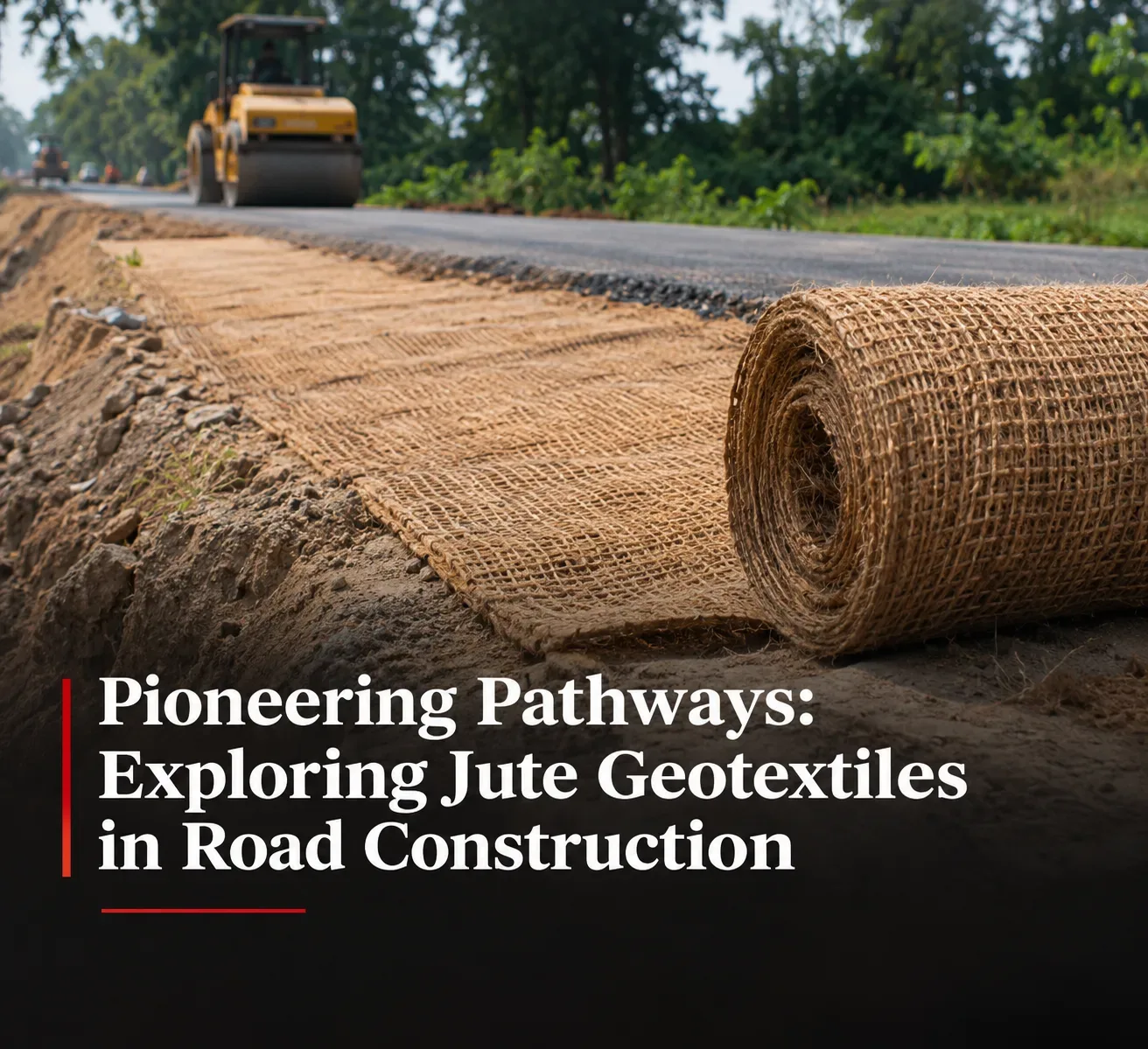
One type of fiber that tackles geo-technical issues is jute. It is made of several types of coir geotextile, jute geotextile, and blends of various fibers. Geotextiles can be used to manage mild landslides, eroding slopes of roads and railroad embankments, river embankments, and the management of solid waste. They can also prevent railway track settlement. Currently, roughly 20,000 tons of jute are utilized worldwide for geo textiles, making up about 2% of the market. Since 1980, the jute geo textile market has grown by twofold.
Jute geo textile has some benefits. It is biodegradable and does not degrade soil fertility. It is highly hygroscopic and can absorb water as well as help consolidate soil, increase soil flexibility, and, most importantly, it is less expensive than synthetic fibers. Because raw materials are locally available, this item can be produced in the country's jute mills. This can even be made from low-quality jute
In Bangladesh,Jute geo textile has previously been used locally in projects such as the Hatirjheel project, the road from the Prime Minister's office to Agargaon in the capital, the Pakulla-Lawhati road in Tangail, the 7 km road between Dhaka and Sylhet Highway, Thanchi-Alikadam road, Pathoraj river bank protection,Noabenki-Garazehat-Harinagarhat LGED road Shayamnagar. It is now used all over the world, including the United States and Australia. It is less harmful to the environment than traditional geotextiles. Bangladesh is the leading producer of jute geotextiles. It's a novel concept, and if the use of geo textiles could be expanded, jute demand and cultivation would skyrocket.
Fields of geo-textile application:
The main functions of geo-textiles make them suitable for application to many practical problems (Ingold& Miller, 1988). These are a few of the applications:
• Yards and temporary roads • Permanent highways • Permanent road repair • Railway lines • Soft ground embankments • Applications for drainage • Applications for retaining walls • Erosion prevention The majority of these applications are especially well suited to the geological features found in many parts of India, Bangladesh, South-East Asia, China, and Japan. In these areas, large areas of alluvial and marine deposits contain soft clay with high compressibility and low shear strength. Even with minor superimposed loads, they cause stability and settlement issues.Geosynthetics have been widely used in various construction projects in India in recent years. These materials are highly resistant to biological and chemical degradation, and they have the tensile strength and permeability required for direct ground treatment applications. Geotextiles made of natural fibers, such as jute, have high permeability but are biodegradable and have lower tensile strength in general. They have not received as much attention as geosynthetics. As a result, their application has been limited thus far.
A practical observation of soil erosion control and slope stability using jute
Case Study: Soil Erosion Control and Slope Stability Using JGT on Dhaka-Sylhet Highway Project Overview: • Design and Implementation: Dr. Zahid Hossain Prodhan, in collaboration with the Bangladesh Roads and Highways Division and funded by the World Bank and the Government of Bangladesh. • Objective: To mitigate soil erosion and stabilize slopes along a 7 km stretch near Bhairab, approximately 80 km from Dhaka. Process and Outcomes: The project utilized chemically treated JGT for erosion control and slope protection. Treatments included rot prevention and flexibility enhancement to extend the material’s lifespan to over a decade. The implementation process involved fabric chemical treatment, drainage preparation, and JGT installation on prepared soil surfaces. The results demonstrated improved soil stability and reduced erosion, with significant cost savings compared to synthetic alternatives. Advantages of JGT: • Biodegradability, enhancing soil fertility • Cost-effectiveness and local availability • High water absorption capacity for soil consolidation • Environmentally friendly interaction with soil masses Salient features of Technology:
1. It improves the stability of reinforced earth structures. 2. It creates an environmentally friendly interaction between the soil mass and the Jute Geotextile. The section of the Dhaka-Sylhet Highway that requires protection from soil erosion consists primarily of sand-silted soil that is prone to damage and erosion from floods and other natural processes. The use of Jute Geotextiles for erosion control and slope protection is likely to provide the best solution. Jute Geotextile Benefits: Jute Geotextile is significantly less expensive than any other synthetic fiber available locally. It blends easily with soil mass to provide stability. Jute Geo textile is both environmentally friendly and unprocessed jute is water repellent which has a phobia towards water.
IMPLEMENTATION PROCESS
Materials => Carrying => Treatment =>Labour =>Logistics
Miscellaneous =>Design & Supervision
Stage 1: Jute Fabric Chemical Treatment:
Jute fiber typically swells and degrades in water within six months. As a result, some chemical treatment is required to extend its life. Jute Geotextile is expected to last for about ten years after treatment. Among the treatments are:
1. Treatment for rot prevention 2. Treatment for removing natural impurities 3. Treatment with a material of a specific density 4. Treatment with a viscosity-specific material 5. Grease treatment based on calcium. 6. Treatment for improving flexibility Stage 2: Filtration and drainage 1. Geotextile made of jute 2. Horizontal Drain Preparation 3. Vertical Drain Preparation
Stage 3: After levelling, dressing, and manual compaction to a specified level, Jute Geotextile is laid in accordance with the approved design.
Types of Jute Geo-textiles (JGT) selected for Bangladesh For rural road Construction : 627,724,and 760 gsm (woven)
For river Bank Protection : 627 Gsm (woven, Bitumen or otherwise treated)
For Hill Slope Management : 500,600 and 700 gsm (open Weave)
Application of JGT:
Type of Application Location District/Upazilla Executing agency
Rural road Turag-Rohitpur- Dhaka/Keranigonj RHD construction Bourvita road
Rural road Circular road Savar Dhaka/Savar LGED & SWO construction Cantonment
Rural road NoabenkiShamnagar Satkhira/ Shamnagar LGED construction Road
Rural road South Para(Kanda Bancharampur/Brahmanbaria LGED construction Para) Road
Rural road Tezkhali-Titas river- Bancharampur/Brahmanbaria LGED construction Chandumia Road
Rural road Pakulla-Lawhati Tangail APDL & LGED
Rural road Dhaka-Sylhet RHD construction(Slope) Highway
Rural road Saibor-Kaligang- Lohagara/Narail LGED construction Mithapur bazaar Road
River Bank Pathoraj River Panchagar/Boda BWDB Protection
River Bank Garai River Rajbari/Baliakandi BWDB Protection
River Bank MadarpurBeel Route Mkshodpur/Gopalganj BWDB Protection (MBR) Channel
River Bank Shakbaria river Koyra/Satkhira-2 BWDB Protection
River Bank Kazibacha river Batiaghat/Khulna BWDB Protection
Hill Slope Thanchi-Alikadam Thanchi/Bandarban SWO Management Road (36 Meter Uphill Segment) Located on 14.75 km point
Hill Slope Thanchi-Alikadam Thanchi/Bandarban SWO Management Road (18 Meter Downhill Segment) Located on 11.7 km point
3.2 Organizations Involved with jute Geo-textile Project Bangladesh University of Engineering and Technology (BUET)
Bangladesh Jute Research Institute (BJRI)
Soil Resources Development Institute (SRDI)
Local Government Engineering Department (LGED)
Bangladesh Water Development Board (BWDB)
Roads and Highway Department (RHD)
Special Works Organization (SWO) of Armed Forces Division
Bangladesh Jute Mills Corporation (BJMC)
Janata Jute Mills Limited (JJML)
Arcadia Property Development Ltd. ( APDL)
Jute Diversification Promotion Centre ( JPDC )
Proposed Strategy for jute geo-textile:
Bangladesh must diversify in order to reclaim the golden age of jute. Jute Geotextile is one of these elements of various approaches. Jute geotextile is becoming increasingly popular in the international market. The following steps can be taken to increase demand and hold the jute geotextile market.
The supply and demand principle underpins all market economics. The goal is to constantly increase demand while also balancing supply and demand. If supply fails to meet demand in the market, the purchaser has a reliable alternative sources of supply. There is already a market for erosion control products made from jute geotextiles, but supply is falling short of demand. If this situation continues, the jute geotextile market will die.
At the moment, the selling market is a price-driven technology market. In other words, the product is a low-tech product that is exported at a low cost. Foreign importers and distributors create demand for the product because they can make a lot of money selling it to the end user. By selling more products at the current profit margin, the jute geotextile manufacturer can make more money. Profit margins can be increased further by adding value to the product. Normally, Bangladesh exports basic jute geotextile that has not been treated in any way. Because the superior product, application technology, and product promotion have been invested in, the product can be sold at a higher profit margin than its inferior competition. Jute geotextiles can be improved by treating them according to their intended use. Unfortunately, the currently available jute geotextile has no market in a commercially developed country. However, the market for this product in developed countries has recently increased.
Discussion & Result The works described in this paper primarily concern the use of JGT in road construction, erosion control, and hill stabilization. Road design and erosion control are more important in Bangladesh. We discovered that the treated JGT is used in road construction. As a result, the road strength and durability are higher than on a normal road without JGT. We also discovered that the roads are becoming stronger by the day. 627 and 724 GSM are commonly used in rural road construction. However, depending on the road's condition, less GSM may be used in road construction. Woven jute fabrics are more commonly used for this purpose. We also discovered that JGT was used in the hatirjheel project which was implemented by Bangladesh Army. On January 2, 2013, it was opened.The currently is in good condition. We were also aware of the Dhaka-Shylet highway. Now that road's performance is also good, and it is being monitored for JGT standardization and accreditation. Synthetic geotextile is very expensive, and it must be imported using foreign currency. Bangladesh is a flood-prone region. We have to spend a lot of money to keep our rural roads in good condition. So we could use Jute Geotextile to keep our communication network operational all year.Jute as a geotechnical apparatus in construction is easily available in the global market and moreover it's more sustainable than synthetic apparatus. Geotextiles are extremely useful in a variety of applications, particularly civil construction.

Written by
Mahi Abrar
Mahi Abrar reports for News Trial, covering the stories that matter with fast, fair and factual journalism. The world, in seconds.